This excerpt is from the Invisible Women Newsletter. Click here to join the 50k+ subscribers and read the full article.
In Invisible Women I wrote that “when planners fail to account for gender, public spaces become male spaces by default,” and this week I’d like to talk about two really interesting if disheartening heat maps which both starkly illustrate this truth.
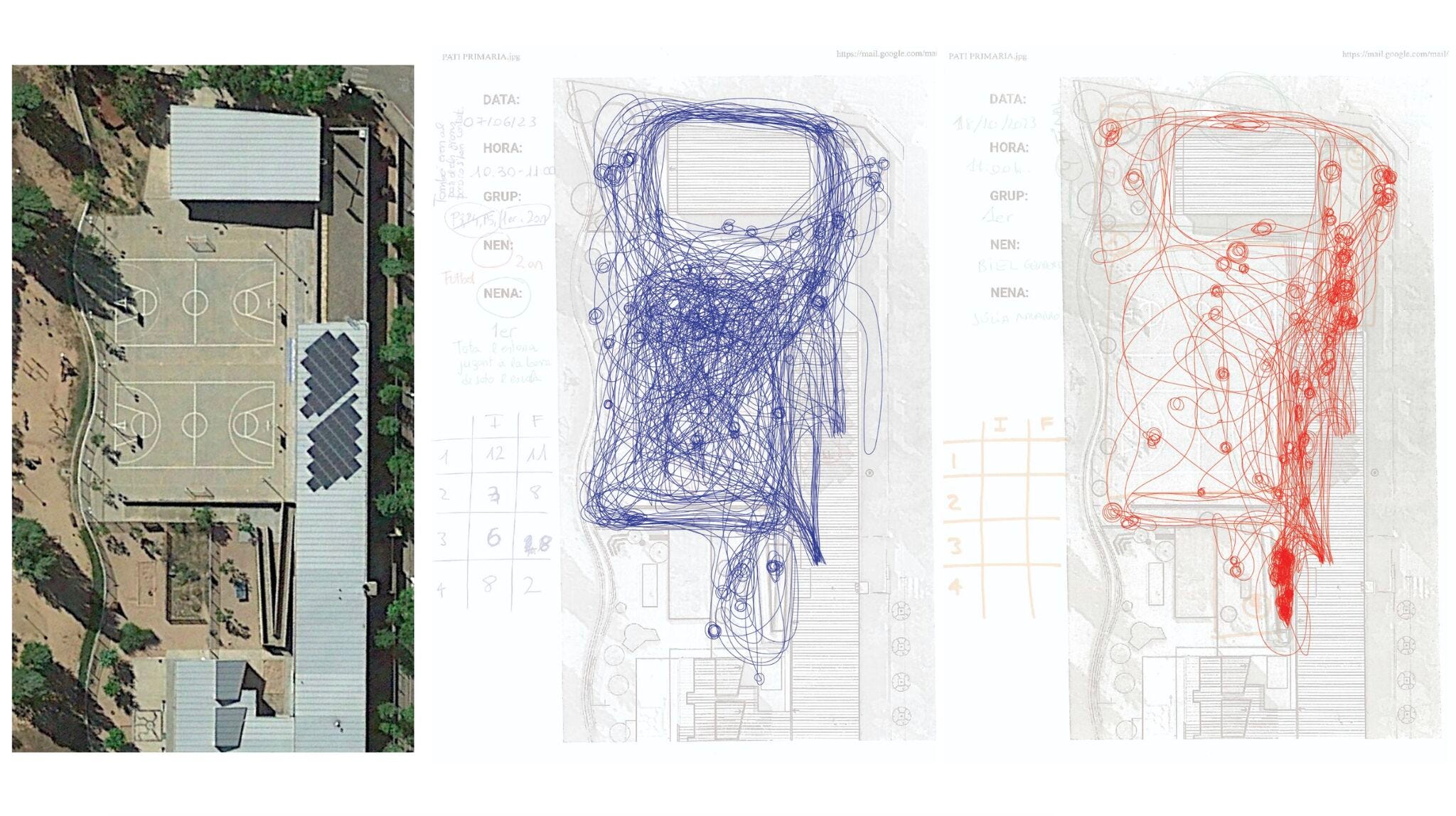
Here is the first one, contrasting how boys (blue) versus girls (red) used the space in a playground in Catalunya in Spain:
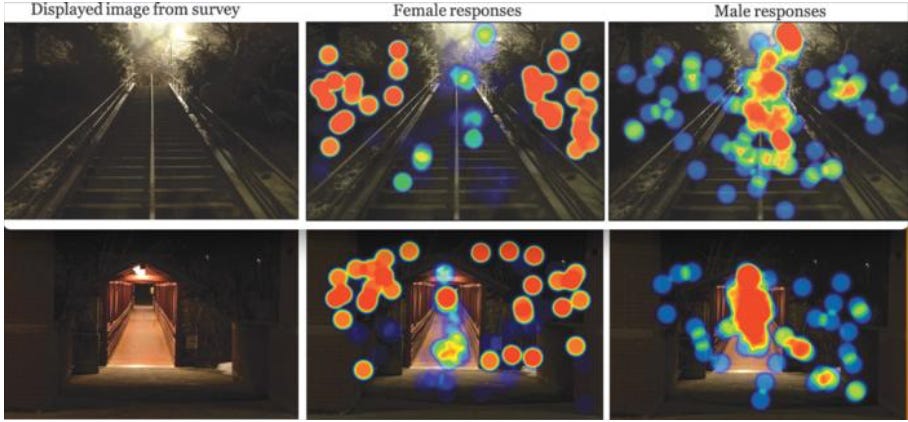
And here’s the second, which contrasts where men and women focus their gaze when walking in the hours of darkness:
To state the obvious, these images highlight just how inequitable women’s access to public space really is compared to men.
In the first example, while boys are running around all over the place, making full use of the space provided to them, girls are for the most part restricted to the peripheries of the playground. Interestingly, there was one place where the girls did dominate: in a tiny section towards the bottom right of the image. This small slice of default female playground was, said one of the researchers, under the stairs — which will not be a surprise to anyone who listened to Visible Women, episode 2; as we reported in that episode, girls search out the “in between spaces” where they will not come into conflict with boys for their use of a supposedly shared space.
The second example, while men are mostly focusing on the path ahead, women are scanning the peripheries, keeping an eye on bushes and dark areas. This data cannot tell us what is in the heads of these men and women, but by combining it with what we know about how men and women experience public spaces, coupled with the fact that the sex differences were, explained the researchers, most pronounced when the path was in darkness or there was no easy escape route, we can reach a fairly convincing interpretation of what is going on here.
The women are scanning the area for potential threats, looking for their escape route if needed. I feel pretty confident in this analysis given not only my research for Invisible Women, but also because this is how I, personally, navigate dark urban areas and I never fail to feel furious about it. I wish I didn’t — I wish I didn’t feel I had to. I wish none of us did. If we could somehow harness the amount of mental energy women waste on this hyper vigilance we’ve had foisted on us by the world in which we live, this constant underlying, subconscious scanning for threats, we could probably, I dunno, power a reasonably-sized British seaside town. It’s such a WASTE. Just think what we could be doing instead! Not least: looking where we’re going! Which is what the men in this study are doing, peacefully undistracted by concerns about their personal safety.
This kind of reminds me of the various men who’ve emailed me having had a revelation in conversation with their female partner about running after dark: the revelation being that they have just discovered that while they wouldn’t think twice about running after dark, their female partner wouldn’t countenance it for a second. And they had no idea. No idea because they’d never spoken about it before — no idea because they’d never thought to speak about it. And no shade intended to these men, who are good, thoughtful men who love the women in their lives and do not want them to be walking around in this state of constant threat-assessment. But the reality is, most men simply have no idea how much time we spend scanning for threats because they just don’t do it themselves. As this study illustrates they are, instead, focused on the path ahead.
To read the rest of this newsletter