This excerpt is from the Invisible Women Newsletter. Click here to join the 50k+ subscribers and read the full article.
“….Two papers caught my eye this week, GFPs, both of them at least partly about unpaid care data gaps, with one in particular highlighting how gendered data gaps don’t have to come in the obvious guise of simply forgetting that women exist, but can instead result from gendered gaps in analysis — even when that analysis is literally about women.
First up this week I’m inviting you to join me in reeling from the staggering revelation from the World Bank that their analyses of how laws around the world affect women’s economic opportunities have historically been sporting some rather gaping gendered data gaps. For the past nine years (this years’ is the tenth annual report) the World Bank has failed to consider how childcare (or a lack thereof) and safety (and again, or a lack thereof) affect women’s ability to engage in paid work.
This gap is, as I said, staggering — at least it is to me. As anyone who’s read Invisible Women may remember, unpaid care work and violence against women were two out of the three central themes I identified (the third being the female body) that “define women’s relationship with the world” — so the idea that anyone could embark on a data analysis project about women and work without considering two such key factors (much less to then do it again and again over nine years) is, well, simply staggering. The mother (haha) of all data gaps.
Still, to their credit, this is a gap they have filled in this year’s report — and the result is a more accurate (although considerably less rosy) analysis. When the dataset excluded the impact childcare and safety had on women’s ability to engage in paid work, women were found to enjoy three-quarters of “the legal rights available to men.” So, not perfect, for sure. Definitely room for improvement. But nevertheless significantly superior to the two-thirds of legal rights calculated when laws and policies related to childcare and safety were factored into the equation.
When these additional indicators are taken into consideration, no country provides equal opportunity for women.
The report found that the biggest gaps in policy concern women’s safety, with women enjoying on average “barely a third” of the legal protections against violence. The report identified significant gaps when it came to addressing the impact of sexual violence on women’s ability to enter the paid workforce, with more than 90 percent of economies lacking “comprehensive legal provisions for safety.”
For example, while 151 out of the 190 countries studied “have laws in place prohibiting sexual harassment in the workplace,” only thirty-nine have laws “prohibiting it in public spaces such as mass transit.” And how, as the report notes, “can we expect women to prosper at work when it is dangerous for them just to travel to work?” Meanwhile, 139 economies “lack adequate legislation prohibiting child marriage, which typically quashes a girl’s future educational and economic opportunities.”
As for the second new indicator, childcare (it would be good to see this expanded in future years to include other types of unpaid work like caring for older people) was also found to have a significant impact on women’s ability to engage in the paid workforce, with most countries scoring poorly. Less than half of all economies provide some financial support or tax breaks for parents with young children.
Only two in 10 potential parents live in countries with a statutory provision of childcare for children under three years of age, while only one in 10 potential parents can use publicly organized childcare services just after the birth of their children, avoiding any break between the end of statutory care leave (where it exists) and the start of early childcare entitlements
That “where it exists” bit is important by the way, given the paucity of leave earmarked for fathers who receive on average only 25 days of paid leave compared to women’s 196 days. Meanwhile 65% of economics offer fathers at least one day of paid leave for the birth of a child — but only 16% provide any form of incentive for men to actually take their leave, which readers of Invisible Women will remember is kind of crucial since all sorts of pressures from social to financial make it harder for men to take parental leave. And, as readers of IW will ALSO remember, men taking parental leave has a hugely significant impact on women’s future earnings and engagement in paid work. (Although it has to be said, I’m not convinced one day of leave is going to really achieve much at all).
The report is really worth reading in full, as it covers all sorts of other really interesting factors that affect women’s economic empowerment, from pensions not accounting for the time women have to take off paid labour (see IW, pp.77-78 also on this) to a very revealing analysis (also included in this report for the first time) that compares rights on paper to their enforcement in practice: perhaps unsurprisingly, we are doing pretty poorly here too.
While “the laws on the books imply that women that women enjoy roughly 64 percent of the rights of men” countries have, on average, “established less than 40 percent of the systems needed for full implementation.” For example, fifty-two per cent of countries have laws “mandating equal pay for women for work of equal value,” but only 18% have any measures (like pay transparency) to make these laws enforceable.
Underlying all of this is a pervasive failure by all countries studied to systematically collect sex-disaggregated data. Over the last three years, for example, only 46 out of the 190 economies studied published sex-disaggregated data on unpaid care work, with sex-disaggregated time-use data (see IW, p.242-3) being “frequently unavailable.”
The historic data gaps in this report are a really important reminder that it’s not enough to simply say “we will collect data on women.” You first have to know what the right questions are to ask; and if you haven’t considered the impact of gender, you will end up making some serious mistakes.
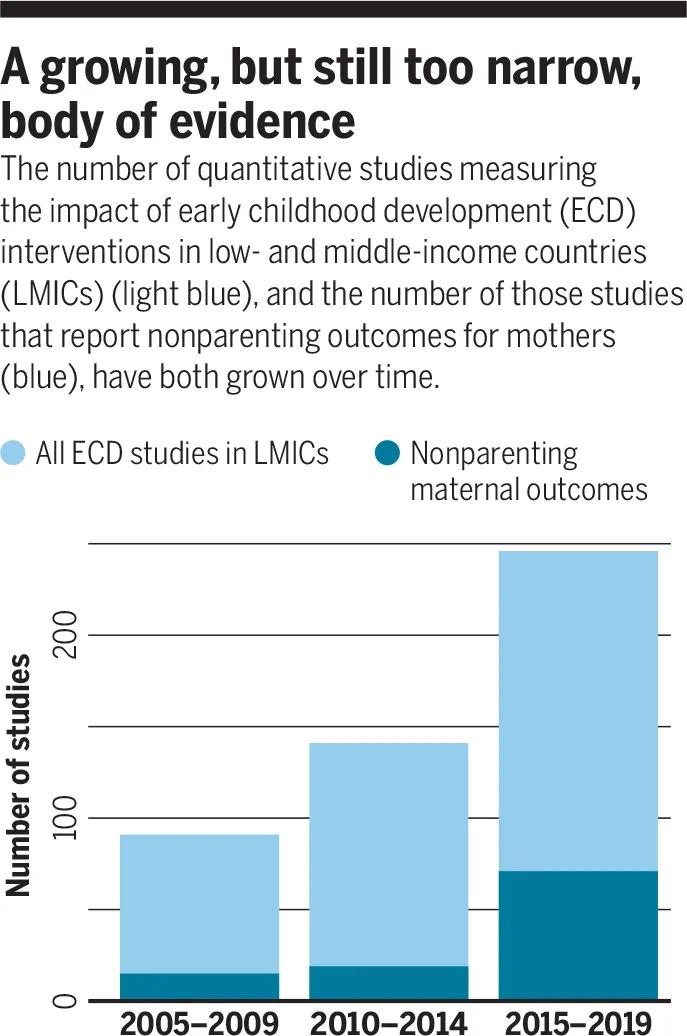
Which leads us to the second paper that I’d like to submit for your consideration. This paper looked at 478 studies published between 2005 and 2019 that evaluated early childhood development (ECD) interventions and asked: what proportion of them considered the impact of these interventions on the mother?
The answer is: not many.
Only 22% reported any “mother-specific outcomes that are not exclusively focused on parenting practices”. Only 19 studies (4%) looked at the impact of the intervention on the mother’s labour market outcomes, and only six (1%) reported outcomes related to other aspects of women’s empowerment.
But why, you might ask, does this matter? After all, doesn’t it make sense to evaluate these interventions, as 91% of studies do, from the perspective of their impact on the child?”
To read the rest of this newsletter (and find out why the advice to women to network their way into advancing their career…may be default male advice) click here.