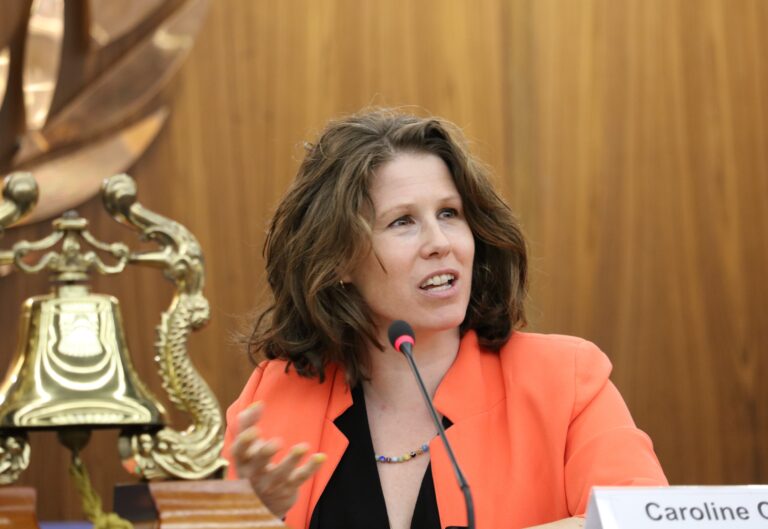
From car safety to medical drugs, from public policy to AI, the world has been designed for only 50% of the population. Since its release in 2019, Caroline’s bestselling expose of the worldwide gender data gap has sold over a million copies worldwide, has been translated into over 30 languages, and won numerous awards. And, for governments, NGOs and leading organisations, Invisible Women continues to influence policy, product design and research.
Hear firsthand from Caroline about the findings from her book, what’s happened since it was released and her on-going research as she explores what it takes to create a world that works for everyone
What Caroline Explores
What is the Gender Data Gap and, more importantly, why does it matter now? In this talk, Caroline shows how:- The Gender Data Gap Shapes Our World
- The gender data gap refers to the systematic lack of data about women and gender differences in research, policy, technology, and design. In short: much of the data used to make decisions in science, medicine, business, and society has historically been collected by men, about men, and for men — leading to blind spots that disadvantage women.
- Examples include:
- Medicine: women were excluded from many clinical trials until the 1990s which mean that, as a result, drug dosages, side effects, and symptoms of diseases (like heart attacks) are often based on male physiology). Women are 50% more likely to be misdiagnosed after a heart attack.
- Technology: voice recognition systems and facial recognition algorithms perform worse for women because training data skews male. The same is true for smartphone sizes, car seatbelts, and protective equipment.
- Work and Economics: Economic and labor data frequently ignore unpaid care work (mostly done by women). This undervalues women’s contributions to GDP and affects policy decisions.
- Urban Planning and Safety: Public transport routes, lighting, and park layouts are often designed without considering women’s mobility patterns or safety concerns.
- Women Are Still Being Left Behind:
- Despite progress, women remain underrepresented in datasets that drive AI, product design, medicine, and workplace policy.
- Particularly now, algorithms and analytics built on biased or incomplete data risk reinforcing inequities rather than fixing them.
- A 2025 study titled “Who Gets the Callback? Generative AI and Gender Bias” audited open-source LLMs across ~332,000 real job postings. The study found that women are less likely to be recommended (i.e., receive “callbacks”) than men especially for higher-wage, male-dominated occupations.
- A 2025 study found that AI tools used by English councils downplay women’s health issues, perpetuate regressive gender stereotypes
- Addressing the Gender Data Gap Reduces Inequality and Drives Innovation
- Since the release of Invisible Women in 2019, there have been encouraging steps taken by governments and organizations that have led to better outcomes for women and innovative product designs. Examples include AI that helps diagnoses heart attacks in women, AI that helps radiologists spot breast cancer in real-world tests and AI used to design safer seat belts.
- Make Space for Girls campaigns for facilities and public spaces to be designed with the needs of teenage girls in mind and was directly inspired by Invisible Women.
Why Book Caroline Now
We are living in a time of rapid digital transformation, AI expansion, global economic uncertainty, and a push for social equity — all of which make inclusive, accurate data more critical than ever.
Caroline’s keynote addresses the need for data-driven campaigners and shows how to make meaningful change in your own community.
Learn how to spot and correct biased data:
- As AI tools and machine learning systems are adopted more widely, they rely heavily on historical data — much of which underrepresents or misrepresents women.
- Organisations using biased data to train AI risk baking inequality into algorithms, whether in hiring, healthcare, finance, or customer service.
- Fixing the gender data gap ensures AI works fairly for everyone.
Design resilient and inclusive systems:
- Climate change, economic instability, and conflicts disproportionately affect women, but gender-disaggregated data is often missing in disaster response, policy planning, and resource allocation.
Build workplaces that foster talent and deliver sustainable results
- Despite progress, pay gaps, underrepresentation in leadership, and barriers in tech and STEM remain. Gender-specific data on recruitment, retention, promotion, and pay is necessary for effective action. And, in 2025, investors, regulators, and employees are demanding data-driven transparency around gender equality.
- In 2025, markets are saturated — but underserved groups (including women) represent untapped opportunities. Accurate gender data allows organizations to design products, services, and policies that will answer real needs and win customer loyalty.
Why Audiences Choose Caroline
Caroline’s presentations have fundamentally shifted how scholars, policymakers, and practitioners think about data, evidence, and knowledge creation. Her speaking engagements consistently receive praise for making complex research accessible while maintaining intellectual rigor.
Through her keynotes and presentations, Caroline helps audiences understand that inclusive approaches to data are not merely matters of fairness, but essential components of accurate understanding and effective action.
Her ongoing commitment to rigorous inquiry and engaging communication continues to illuminate new dimensions of how knowledge is constructed and how it might be made more complete.
What Audiences Are Saying
It was a fantastic event. The talk itself could have continued for another hour!eBay
An eye opening presentation and I know that our employees gained a lot from taking the time and listening in on it. J.P. Morgan
Caroline was fantastic and the feedback from our team has been glowing!…It was an eye opening conversation for so many on our team.
MIO Partners
We absolutely loved hosting Caroline. She was superb, engaging and left our audience with the facts and data they need to address gender bias in both their personal and professional lives.
Trouble Club
Speaking Engagements
Caroline accepts a limited number of keynote presentations each year, focusing on opportunities to address leading organizations and institutions who are working to make the world a better place.
Each presentation is thoughtfully prepared for the specific audience and context, ensuring relevance and depth appropriate to the questions being explored.
To enquire about booking Caroline please contact Michael at [email protected]