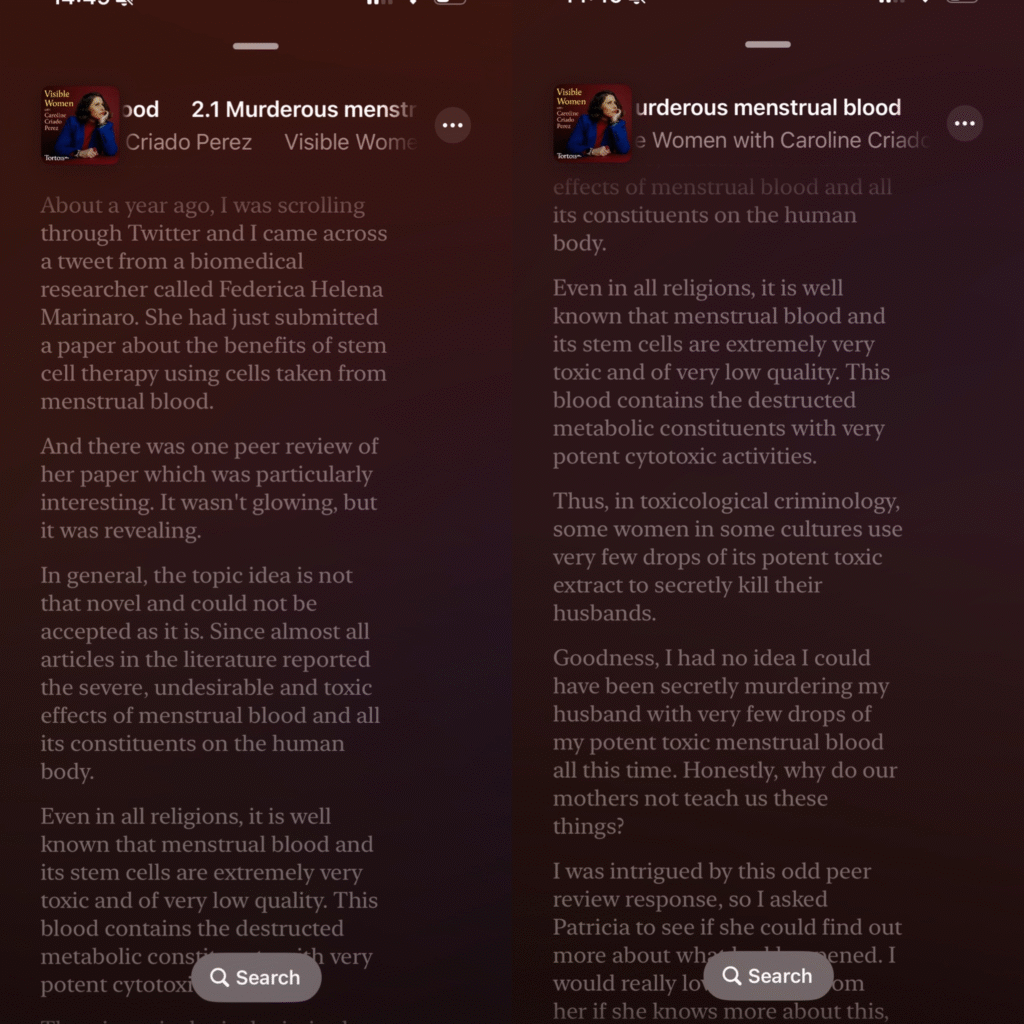
Marinaro had just submitted a paper about the benefits of stem cell therapy using cells taken from menstrual blood, and she shared one of the peer review responses online. Unfortunately, the original tweet has been deleted, a loss to comedy for which I am holding Elon Musk personally responsible, but thankfully I have a record of what the response was because I read it out on a podcast episode I made the following year; you can of course listen (you should listen!) but because I’m extremely kind, I’ve screen grabbed the transcript of the relevant section for your reading delight:
The good news is, researchers have found an alternative use for menstrual blood and that is to diagnose endometriosis, an extremely painful disorder that can have serious ramifications for women’s fertility and their health more broadly. As GFPs will be aware from both my book and several newsletters on the topic, despite the fact that it is as common in women as diabetes, we remain terrible at diagnosing endometriosis, with women waiting up to a decade for any answers, let alone any treatment.
Existing diagnostic approaches involve intravenous blood tests and laboratory analyses coupled with imaging studies and extensive patient history collection for clinicians to make a definitive diagnosis. Such challenges contribute to delays in diagnosing endometriosis, with one study of 218 women revealing a delay of up to 12 years in the United States.
Enter: your period. Well, ok, your period has already entered the room, since this is of course not the first time we’ve spoken about using your period blood to diagnose a range of diseases, including endometriosis (IIRC we went into this in some detail in the podcast). What’s new here is the test that researchers have developed, which can detect endometriosis-linked proteins in your menstrual blood at much lower levels than in traditional tests, which could make early diagnosis much more feasible. Even better: since the test uses menstrual blood as opposed to intravenous blood, this is a test you could theoretically do at home on your own, rather like a pregnancy test — it could even be integrated into a menstrual pad, meaning you could be getting your endo diagnosis as you simply go about your day.
So far, this study just delivers proof of concept. Next up are clinical trials — and, (and this bit made me particularly excited) expanding the test “to detect additional disease biomarkers such as HPV and cervical cancer.” No more smears AND no more swabs? Please, you’re spoiling us! Future us, anyway. And specifically future us who haven’t yet reached menopause and still have periods. BUT STILL. This would be a major step forward for millions of women and overall, I am declaring it OFFICIALLY MORE GOOD NEWS.
This website uses cookies on to give you the most relevant experience by remembering your preferences and repeat visits. By clicking “Accept”, you consent to the use of these cookies.
This website uses cookies to improve your experience while you navigate through the website. Out of these cookies, the cookies that are categorized as necessary are stored on your browser as they are essential for the working of basic functionalities of the website. We also use third-party cookies that help us analyze and understand how you use this website. These cookies will be stored in your browser only with your consent. You also have the option to opt-out of these cookies. But opting out of some of these cookies may have an effect on your browsing experience.
Necessary cookies are absolutely essential for the website to function properly. This category only includes cookies that ensures basic functionalities and security features of the website. These cookies do not store any personal information.
Any cookies that may not be particularly necessary for the website to function and is used specifically to collect user personal data via analytics, ads, other embedded contents are termed as non-necessary cookies. It is mandatory to procure user consent prior to running these cookies on your website.